Will Moore’s New Editorial Post

We congratulate our board member William D. Moore as he starts a four year term as co-editor of Buildings and Landscapes: Journal of the Vernacular Architecture Forum.

Published twice a year by the University of Minnesota Press, Buildings and Landscapes is an interdisciplinary scholarly journal analyzing the common built environment of North America.

Dr. Moore, an Associate Professor at Boston University, brings experience on the journal’s editorial board. And, of course, on our board of trustees for the past few years.

Dublin Seminar Annual Meeting, May 19

On Monday, May 19, the Dublin Seminar for New England Folklife will holds its annual meeting for 2025. This is different from the annual conference, which this year will be on June 27–28.

Our by-laws as a non-profit corporation call for an annual meeting of members, with reports from the president and treasurer, elections of officers and trustees, introductions of new members, and reports on the organization’s activities.

The annual meeting is also a nice way for the trustees and organizing committees to stay in touch with members who attend the conferences, read the Proceedings, and support the organization as we all work to keep the study of New England Folklife vibrant, interesting, and fun.

At the online meeting on May 19, we’ll hear more about next month’s conference, our close relationship with Historic Deerfield, work on the collections of papers from past conferences, and plans for the future.

If you’ve received an invitation to this meeting as a member of the Dublin Seminar, please log in and share your questions and ideas. Thank you!

Call for Papers from the Ephemera Society

The Ephemera Society of America will hold its 2026 annual conference in Greenwich, Connecticut, on March 20. The theme for that conference is—

250 Years: Ephemera Shapes America

And here’s the society’s call for papers.

Proposals are due by September 15, 2025. For more details and other information, visit the Ephemera Society’s website: https://www.ephemerasociety.org/
Dublin Seminar president receives Distinguished Artist Award

Congratulations to our board president, Marla R. Miller, for receiving the 2025 Distinguished Artist Award from the St. Botolph Club Foundation!

Each year the foundation presents this award to an outstanding practitioner in the field of music, literature, or the visual arts, on a rotating basis. All recipients are New England–based artists who in their careers have produced significant bodies of work and performed effectively as teachers, mentors, and/or activists in their fields.

The club honored Marla Miller as author of Betsy Ross and the Making of America and other “historical nonfiction literature” such as Entangled Lives: Labor, Livelihood, and Landscapes of Change in Rural Massachusetts and The Needle’s Eye: Women and Work in the Age of Revolution.

The St. Botolph Club also noted Marla’s work as an educator: Distinguished Professor of History at UMass Amherst, for twenty years Director of the university’s Public History Program, and now Associate Dean for Strategic Initiatives.

In the spring 2024 “Winterthur Portfolio”

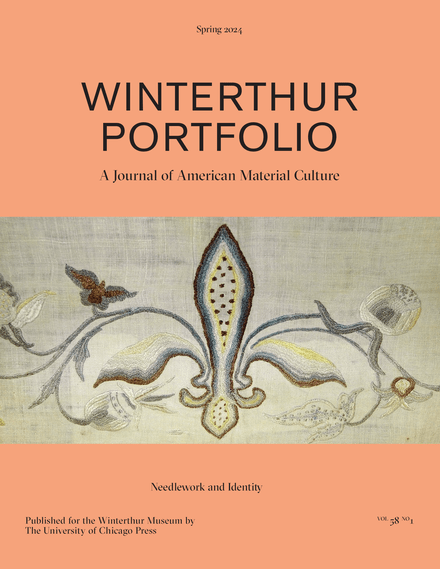
We’re excited to see that the spring 2024 issue of the Winterthur Portfolio includes articles by two Dublin Seminar board members.

Marla R. Miller contributed “Monuments in Flax and Wool: The Memory Work of Heritage Textiles,” examining an heirloom piano scarf embroidered by Mary Wait Allis Hurlbut in 1916 that celebrated both family and regional history.

Erica Lome’s article “Stitching a Lineage: Embroidered Coats of Arms in Eighteenth-Century Boston” looks at the heraldic needlework of genteel schoolgirls and young women, preserving and displaying their family history.

In addition, the issue contains a review by Maggie M. Cao of Margaretta Markle Lovell’s book Painting the Inhabited Landscape: Fitz H. Lane and the Global Reach of Antebellum America. Prof. Lovell was the keynote speaker at our 2024 conference.

Our 2025 Conference Will Be Revolutionary!

Our next annual conference, to be held on June 27–28, 2025, at Historic Deerfield, will be on the subject of Recalling the Revolution in New England.

The conference keynote will be provided by Dr. Zara Anishanslin of the University of Delaware, author of the forthcoming book The Painter’s Fire: A Forgotten History of the Artists who Championed the American Revolution.

Here is our call for papers. Please send us your proposals by January 13. And please spread this news to all scholars who might be interested in presenting or attending. Thank you!

Call for Papers from the Vernacular Architecture Forum, New England chapter

Our colleagues at the New England chapter of the Vernacular Architecture Forum have issued their call for papers for the chapter’s annual meeting in Providence on Saturday, April 5, 2025.

This organization “delves into New England’s rich and diverse vernacular architecture and landscapes in pursuit of a deeper understanding and appreciation of the everyday spaces and places that characterize the region.” 

The submission deadline for proposals is January 13. For all details, see: vafweb.wildapricot.org/NE

“Reawakening Materials” Colloquium at Historic Deerfield, November 7–8

On November 7–8, 2024, Historic Deerfield will host a public, in-person and virtual colloquium focused on its collection of paintings, works on paper, and decorative arts titled “Reawakening Materials: American Art, Empire, and Material Histories in Historic Deerfields Collection.”

Questions of “empire” emerged from an interest in scholars rethinking the American experience from the lens of global European empires (England, Spain, France, The Netherlands, etc.) and U.S. imperialism. Historic Deerfield’s collection focuses on 18th- and 19th-century American art and material culture, and it is based in a landscape tied to Indigenous communities, histories of enslaved people and free people of African descent, and settler colonialism. Our colloquium will explore relationships between empire, materials of objects, and settler colonialism in the collection, specifically asking how these art historical topics can be generative for recontextualizing Historic Deerfield’s place in the study of New England history, art, and culture.

Speakers will investigate materials that reveal new ideas of empire, including: pastels, lacquer, birch, engravings on paper, and linen. The program will also workshop methods for telling these narratives through historic interiors, including objects tied to violence and absence, and opportunities to bring in stories of joy and survivance.

Keynote speaker: Dr. Charmaine Nelson, Provost Professor, Black Diasporic Art & Visual Culture at the University of Massachusetts Amherst

Other scheduled speakers include:

  • Megan Baker, PhD Candidate in Art History, University of Delaware & 2024-2025 Smithsonian Institution Predoctoral Fellow at the Smithsonian American Art Museum and the National Portrait Gallery
  • Dr. Mary Amanda McNeil, Assistant Professor, Department of Studies in Race, Colonialism, and Diaspora, Tufts University
  • Lan Morgan, Associate Curator, Peabody Essex Museum
  • Joseph Litts, PhD Candidate in Art History, Princeton University
  • Dr. Jonathan Square, Assistant Professor of Black Visual Culture, Parsons School of Design
  • Morgan Freeman, PhD Candidate in American Studies, Yale University
  • Michael Hartman, Jonathan Little Cohen Associate Curator of American Art, Hood Museum of Art, Dartmouth College, and PhD Candidate in Art History, University of Delaware
  •  Anthony Trujillo, PhD Candidate in American Studies, Harvard University

Registration and full colloquium schedule: https://www.historic-deerfield.org/events/reawakening-materials-american-art-empire-and-material-histories-in-historic-deerfields-collection/

“Living with Disabilities” Collection Published

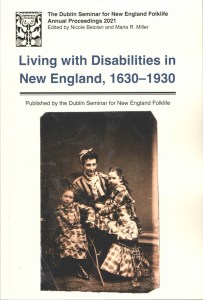
The newest Dublin Seminar volume is Living with Disabilities in New England, 1630–1930, collecting select papers from our virtual conference in June 2021. This volume is now available for purchase from Historic Deerfield.

Contents

Acknowledgments, including appreciations of Peter Benes, Jane Benes, and Phil Zea

Introduction by Nicole Belolan and Marla R. Miller

Part One: Living with Disabilities in Early New England

“The Language of Impairment: Disability among New England Men in the Long Eighteenth Century” by Casey L. Green

“‘By the Providence of God Is Bereaved of Her Reason’: An Eighteenth-Century New England Minister’s Response to Mental Illness” by Ross W. Beales, Jr.

“Hearing the Gospel in a Silent World: Disability, Gender, and Religion in the Massachusetts Bay Colony, 1630-1684” by Katherine R. Ranum

“Heroic and Disabled: Howard Blackburn and the Valorization of the New England Fisherman” by Michael J. Chiarappa

“Fitness for Freedom: The Lived Experience of Disability, Enslavement, and Emancipation in Early New England” by Jerrad P. Pacatte

“‘Useful Members of Society’: Work and Capacity in Deaf and Blind Schools, 1817–1840” by Meg Roberts

“Deafness in Black and White: Integration at the American School for the Deaf, 1825–1870” by Rebecca R. Edwards

“Folklife and the Material Culture of Disability History in Early America” by Nicole Belolan

Part Two: Teaching Disability History

“Infusing Disability History into the Classroom” by Rich Cairn and Graham Warder

“The Return of the Town of Lanesborough, Massachusetts, 1829” by Laurel Daen

“The Petition and Lamentation of Benjamin Fowler” by Benjamin H. Irvin

“The Petition of William Sutton of Boston, Joyner (1706/07)” by Ben Mutschler

Abstracts of Conference Papers Not Appearing in this Publication

Notes on Contributors

Peak Color at Historic Deerfield’s Fall Forum

Historic Deerfield’s 2024 Fall Forum on September 13–14 is titled A Rich and Varied Palette: Coloring New England’s Past. Leading researchers and scholars will explore the vast subject of color and its history, focusing on New England’s specific cultural region.

The program’s lectures will cover such topics as “global colorants and textiles, lithoprints in 1840s New England, painted furniture at the Bath Academy, japanned furniture, Shakers’ color use and meanings, New England’s textile bleaching industries, chrome yellow and pink as pigments, and the paints and finishes of the Rockingham (Vermont) meeting house.”

Despite the pervasive misconception of drabness, New England embraced color as a reflection of refinement and status, a visual display of commerce and the global economy, and a defining element of cultural difference, regional identity, and social and racial hierarchies. Through lectures, workshops, and tours, forum participants will experience the latest scholarship on color and gain a better understanding of the role of color in New England material life.

Historic Deerfield is home to one of the finest collections of New England architecture, interiors, and decorative arts of the 18th and 19th centuries. The museum’s Library also features the superb collection of Stephen L. Wolf (1917–2008), composed of pamphlets, trade catalogs, periodicals, and ephemera on applied color dating from the late 1500s to the present.

The full schedule can be downloaded here in PDF form (in color, of course). People can attend in-person or virtually. In-person registration costs $150, less for Historic Deerfield members and college students; that doesn’t include meals or extras. Virtual registration for the lectures only costs $90 with similar discounts. Register through this page.